Launching a new product or brand: from first followers to massive success
Unleashing a new product or brand onto the world? You want to shout it from the rooftops; the whole world should know! But… is that really the wisest move? We’d like to share our vision with you.
Whether you are a start-up or a renowned brand that has long been nestled in the collective memory of its customers, launching a new (sub)brand, product, or service is an exciting process. Naturally, you want as many people as possible to adopt your innovation. Which steps should you follow when you want to launch a new product or brand?
New, newer, newest!
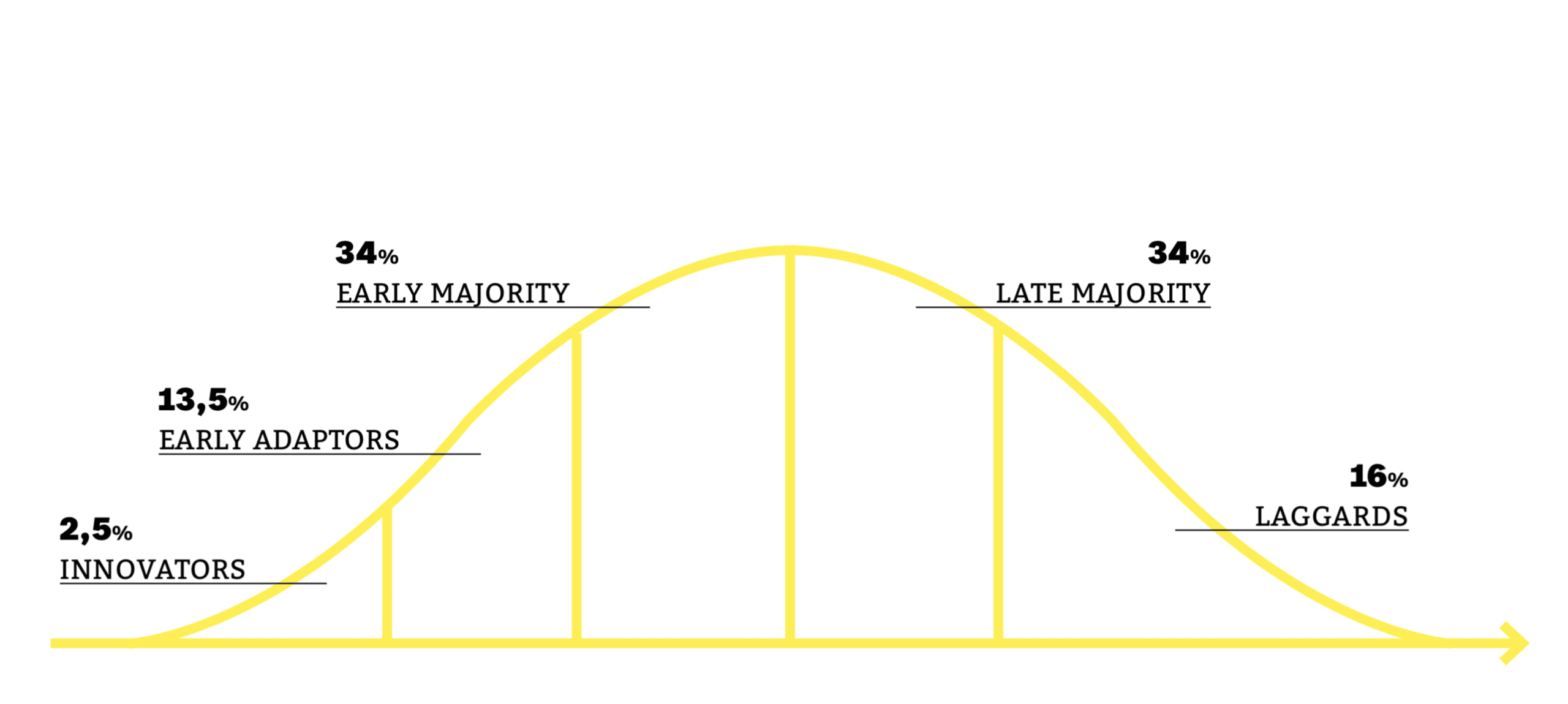
Enter: Rogers’ Diffusion of Innovation theory. This theory describes how people adopt a certain innovation or the path through which your new product or brand will enter the market. In Rogers’ model, we distinguish five stages, always following the same chronology. In each separate stage, a new target group appears on the scene, and each target group views your innovation in a different way.
The 5 target groups
The innovators
They want to be the first to own or try something. This is often a young target group.
The early adopters
They also want to adopt your innovation as trendwatchers or influencers.
The early majority
This group is genuinely interested in your product but has a greater need for ‘proof of concept’.
The late majority
In other words, the slower decision-makers. They are more cautious regarding risks and less inclined to invest in something relatively unknown.
The laggards
They only adopt your product once it has passed its peak, when purchasing it has become a matter of course.
Rogers' innovation curve: in each separate stage, a new target group appears on the scene, and each target group views your innovation in a different way.
While your innovators dive into market novelties and are willing to take a calculated risk, your ‘early adopters’ are slightly more hesitant. They only spring into action once your ‘innovators’ have declared their love for your new brand or product en masse. However, they immediately become the ultimate ambassadors and lead you into the ‘early majority’. And then your train has truly left the station.
What does that mean for you as a brand in practice?
How do you reach that smaller group of future ambassadors? Precisely by claiming that you have ‘the next big thing’ or the latest ‘must-have’ in your hands. We are sometimes asked if it is smart to present your product this way. From our experience: you don’t need a proven success formula to appeal to innovators. In fact, that’s exactly what scares them off.
So, if you have something innovative, hip, or unprecedented, play it up without hesitation. This is exactly what you need to market your product during this launch phase. And from the moment the innovators embrace your brand or product, you’ll have the wind in your sails.
A shortcut to the general public? Red Bull succeeded wonderfully. But not everyone is Red Bull, of course.
Is there a shortcut to the general public?
‘And can you just skip that group of innovators and early adopters to show your product to as many people as possible?’ You certainly wouldn’t be the first to try.
Everyone knows Red Bull, right? Well, in the late 80s and early 90s, that was anything but the case. To change that, their marketers decided to leave massive amounts of empty Red Bull cans in trash cans. They did this in busy city locations, but also near sports stadiums, nightclubs, or popular bars to reach a very specific target audience. This created the impression that their energy drink was already being consumed on a massive scale. In this way, they managed to usher their product directly into the early majority. And the rest is history.
Launching a new product or brand: conclusion?
With an inventive and original marketing approach, you can make a very strong impression. But not everyone is Red Bull. Every innovative brand or product has specific characteristics and moves within a unique context. Therefore: embrace your innovators.