The first post-pandemic Digimeter: 5 key takeaways for SMEs
How digital is the average Fleming? How is the digital landscape evolving? Can we still find our customers on social media? And how has the pandemic changed our digital habits? Imec’s Digimeter is the ultimate tool for mapping the status of digital transformation in Flanders. It consists of 180 pages of data and analysis. But don’t worry—as a marketer or business owner, we’ve distilled the 5 most important takeaways for you.
1. A long-distance relationship with technology
Flemish people are categorized into five profile types based on their relationship with technology. Are you a passionate lover? Do you want no relationship at all? Or do you have more of a long-distance relationship with technology? Interestingly, this last group is growing the fastest, up by 4%.
This refers to people who certainly embrace technology and the digital world, but are simultaneously aware of how time-consuming it is. Consequently, they are more mindful of their usage. Sound familiar? It seems so, as the study shows that over 50% of Flemings are aware that social media takes up too much of their time.
Takeaway
The good news is that the vast majority still has a positive relationship with technology and social media. However, a larger target audience is now deliberately limiting their time online. It is up to us as marketers to focus more on high-quality content. Content that attracts and that people actually want to spend time on. In other words: quality over quantity.
2. Diverse and abundant, but we are all Meta
80% of Flemings use a social media platform every month. Of those users, 82% are active every day on a Meta app such as Facebook. On average, we spend 75 minutes a day on social media, primarily via our smartphones.
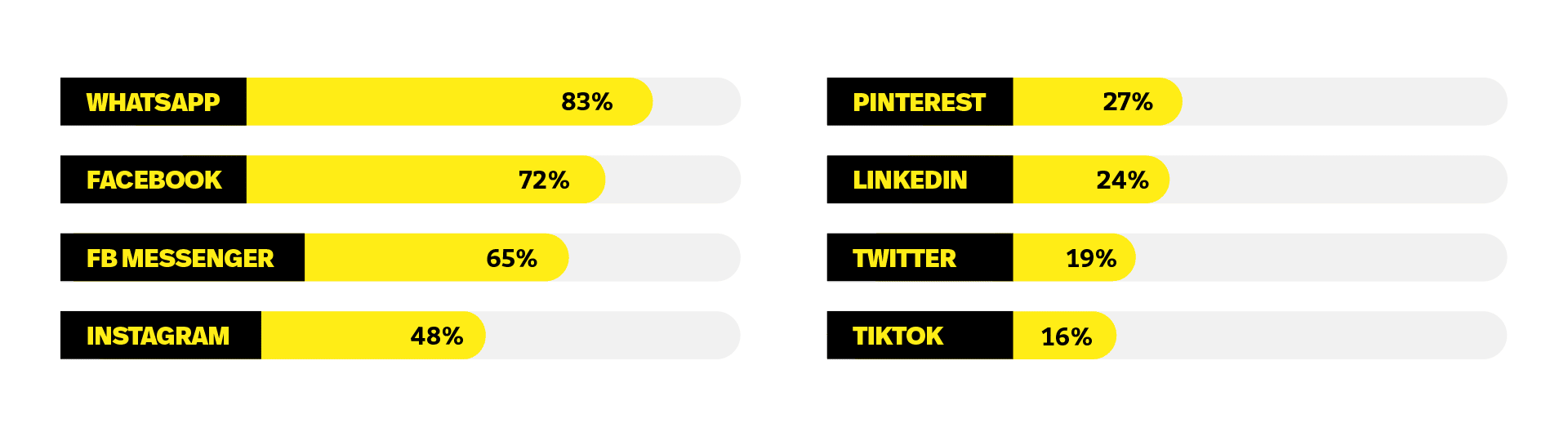
Which apps are the most popular? Despite the many new platforms emerging, traditional social media remains dominant. That said, we are anything but digitally monogamous: 57% are active on more than four platforms simultaneously.
Monthly usage figures:
Takeaway
Want to maximize engagement with your target audience? Then you need to do two things:
- Smartphones are essential, so focus on your mobile offering. How well does your website work on mobile? Can customers or applicants already contact you via WhatsApp on your website?
- We use more than one social media platform, so look for the right mix to reach your target audience. And remember: repetition works! But don’t jump on every hype just for short-term ROI.
3. Online advertising drives purchases
Good news! Nearly 50% of Flemings admit that social media advertising has prompted them to make a purchase. In the 25 to 34 age group, this figure is nearly 60%. This is impressive, considering that over 65% indicate they are aware that social media companies make money from ads.
Takeaway
The message is clear: keep investing in concrete online advertising! Use it in rotation with content marketing and ensure you have the right conversion points to capture data at every stage of the sales funnel.
4. Social media belongs to the over-65s
Is social media only for young people? Far from it! The Digimeter shows that 72% of seniors are active on social media every month. The over-65s are the fastest-growing group, while other age groups show no significant increase or decrease.
Naturally, there is a large age gap between the average users of the major social media platforms. Only Facebook seems relevant to everyone, with an adoption rate of over 65% across all ages. TikTok proves particularly interesting for about 60% of 16 to 24-year-olds.
Takeaway
Base your strategy on data, not trends. Think beyond what you hear in your immediate circle. Just because Facebook isn’t ‘sexy’ anymore doesn’t mean it isn’t a commercially powerful tool. Map out all your buyer personas thoroughly and choose the right medium.
5. A hunger for news, but is it real?
86% of Flemings look for news digitally every day. More than 50% do this via smartphone, followed by radio and computer. The power of the ‘truth paradox’ in the era of fake news is striking: 66% claim to be better informed via the internet, yet 74% worry about false reporting. We also see a need for reliable news. The value of strong news brands has risen significantly, and 74% find it important that a known source is mentioned.
Takeaway
Your customers continue to look for news online. Capitalize on this by providing strong, objective content. Give your news items more impact by linking them to reliable brands or individuals. This emphasizes credibility, which is now more important than ever.
Want to know more? Download the full report here.